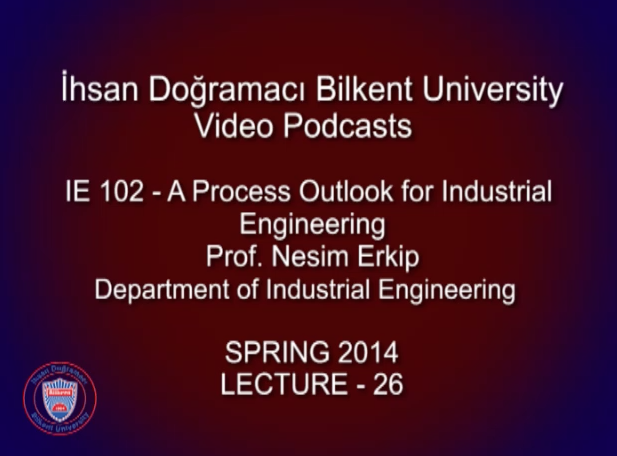
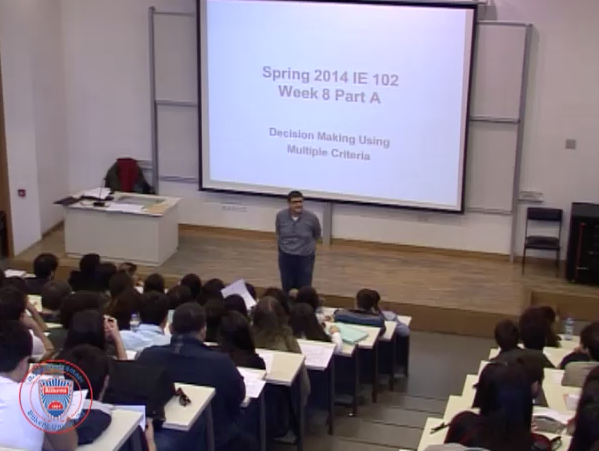
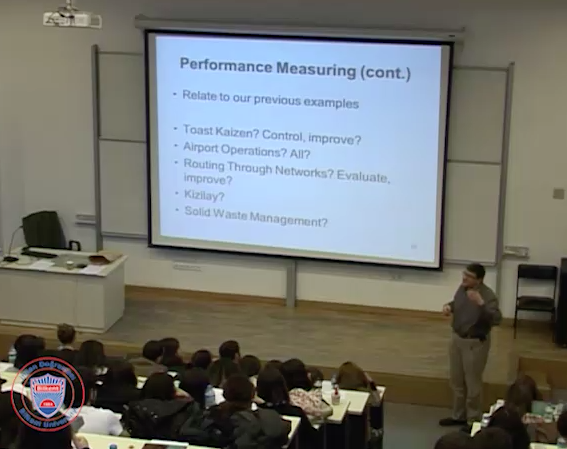
Prof. Nesim Erkip
2013-2014- Bahar
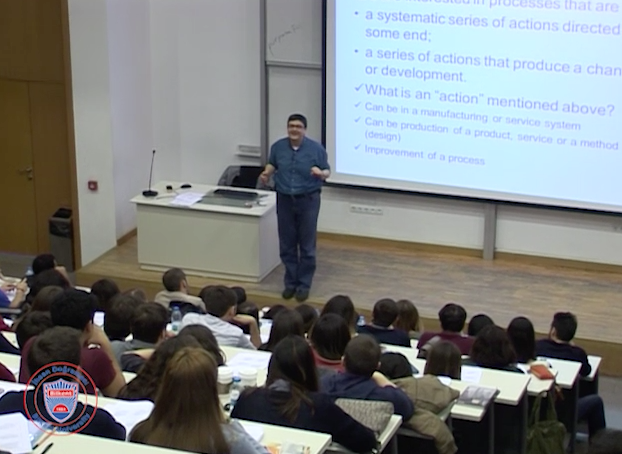
The main objective of the course is to familiarize the IE freshmen with the profession by introducing the basic notion of process. Industrial engineers visualize any systems as a collection of physical and abstract things, each of which are described by a process and these interrelated processes become crucial in the way system functions. Topics related to design of processes and process improvement, as well as notions of performance evaluation are covered and relations to decision making concepts are outlined. Throughout the course simple examples from daily life, as well as more complex examples from the service and manufacturing industries are used.
-
Ders 34 (2014-05-15)
Wrap-up: Video: Definition of IE, Methodology of IE, IE Curriculum at Bilkent University.
Study recommendation: Bilkent IE WEB page, Comments on Exam 2, Lecture Notes
Keywords to remember: All keywords considered previously
-
Ders 33 (2014-05-14)
Wrap-up: Video: Big Bang Theory – Definition of IE, Methodology of IE, IE Curriculum at Bilkent University.
Study recommendation: Bilkent IE WEB page, Comments on Exam 2, Lecture Notes
Keywords to remember: All keywords considered previously
-
Ders 32 (2014-05-07)
Mathematical modeling example: Linear Programming
Keywords to remember: “decision variable”, “performance measure”,
“objective function”, “constraint”, “mapping descriptions into symbols –
mathematical modeling – formulating the problem”, “feasible region”,
“characterization of an optimal solution: corner point – extreme point”
-
Ders 31 (2014-05-07)
Mathematical modeling example: Linear Programming
Keywords to remember: “decision variable”, “performance measure”,
“objective function”, “constraint”, “mapping descriptions into symbols –
mathematical modeling – formulating the problem”, “feasible region”,
“characterization of an optimal solution: corner point – extreme point”
-
Ders 30 (2014-04-24)
Simulation, probabilities.
Keywords to remember: “developing models for randomness”, “simulation”,
“statistics”, “simulation model – representation of reality”, “simulation
is an evaluative model”, “probability”, “probability mass function(pmf)”,
“expected value”
-
Ders 29 (2014-04-11)
Queuing Theory: Under this title, we will analyze waiting lines
Keywords to remember: “randomness”, “arrivals”, “service”, “traffic
intensity”, “expected number in the system”, “expected waiting time”,
“exponential distribution”, “Little’s Law”
-
Ders 28 (2014-04-09)
Queuing Theory: Under this title, we will analyze waiting lines
Keywords to remember: “randomness”, “arrivals”, “service”, “traffic
intensity”, “expected number in the system”, “expected waiting time”,
“exponential distribution”, “Little’s Law”
-
Ders 27 (2014-04-09)
Queuing Theory: Under this title, we will analyze waiting lines
Keywords to remember: “randomness”, “arrivals”, “service”, “traffic
intensity”, “expected number in the system”, “expected waiting time”,
“exponential distribution”, “Little’s Law”
-
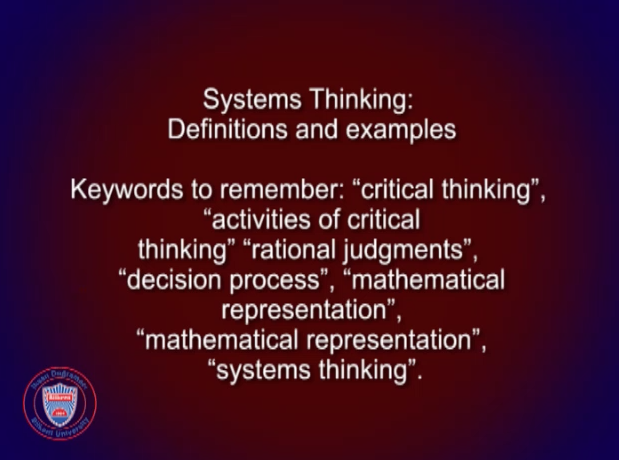
Ders 26 (2014-04-03)
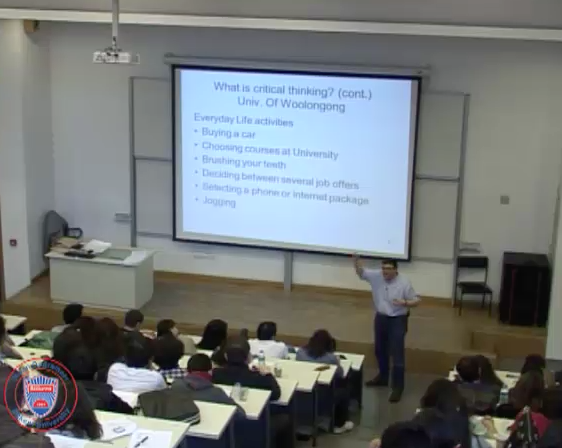
Systems Thinking: Definitions and examples
Keywords to remember: “critical thinking”, “activities of critical
thinking” “rational judgments”, “decision process”, “mathematical
representation”, “mathematical representation”, “systems thinking”.
-
Ders 25 (2014-04-03)
Systems Thinking: Definitions and examples
Keywords to remember: “critical thinking”, “activities of critical
thinking” “rational judgments”, “decision process”, “mathematical
representation”, “mathematical representation”, “systems thinking”.
-
Ders 24 (2014-04-02)
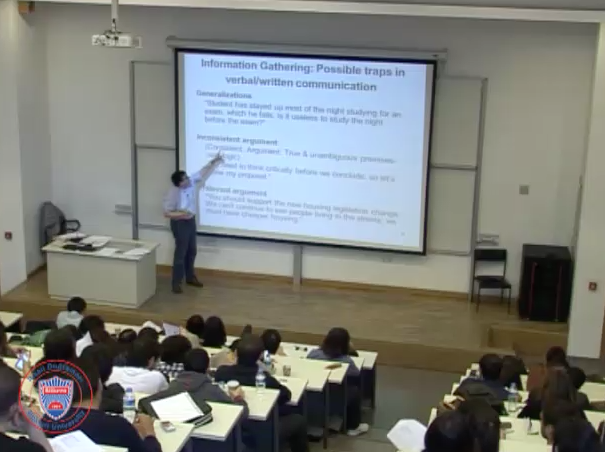
Critical Thinking: Definition; activities of critical thinking; issues in information gathering; examples
Keywords to remember: “critical thinking”, “activities of critical
thinking” “Verbal mapping”, “information source”, “traps (irrelevant
argument, false analogy, etc.)”
-
Ders 23 (2014-04-02)
Critical Thinking: Definition; activities of critical thinking; issues in information gathering; examples
Keywords to remember: “critical thinking”, “activities of critical
thinking” “Verbal mapping”, “information source”, “traps (irrelevant
argument, false analogy, etc.)”
-
Ders 22 (2014-03-27)
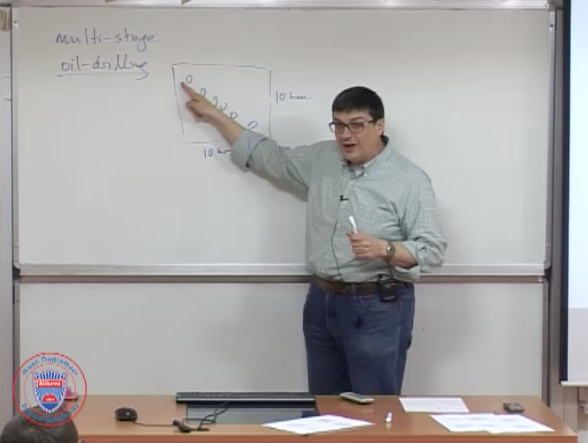
Decision Trees
Keywords to remember: “decision trees”, “chance node”, "multi-stage
decisions"
-
Ders 21 (2014-03-26)
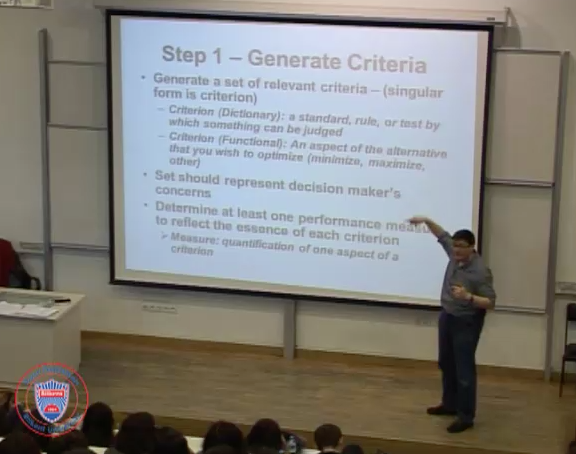
A Framework for decision making under multiple criteria
Keywords to remember: “Set of Alternatives”, “a set of criteria (same as
set of measure or a composite measure)”, “scaling”, “data collection”,
rescaling”, “weighing – assigning relative importance”, “decision
process”, “cost/time trade-off in measuring”
-
Ders 20 (2014-03-26)
A Framework for decision making under multiple criteria
Keywords to remember: “Set of Alternatives”, “a set of criteria (same as
set of measure or a composite measure)”, “scaling”, “data collection”,
rescaling”, “weighing – assigning relative importance”, “decision
process”, “cost/time trade-off in measuring”.
-
Ders 19 (2014-03-20)
Definition of "decision"; relation to performance measure. Example case
Keywords to remember: “Performance Measure”, “decision”, “decision-maker”,
“problem owner”
-
Ders 18 (2014-03-19)
Performance Measure and How to Measure.
Keywords to remember: “Performance Measure”, “effectiveness measures”,
“efficiency measures”, “motivation for measuring performance”, types of
measurement”, “how to measure”, “hierarchy of measures”
-
Ders 17 (2014-03-19)
Wrap-up: Networks
Keywords to remember: “Performance Measure”, “effectiveness measures”,
“efficiency measures”, “motivation for measuring performance”, types of
measurement”, “how to measure”, “hierarchy of measures”
-
Ders 16 (2014-03-13)
A Manufacturing System - Assignment Problem
Keywords to remember: “optimization”, “lower bound”, “structural properties”
-
Ders 15 (2014-03-12)
A Manufacturing System
Keywords to remember: “schedule”, “layout”, “make-to-order”, “assembly”,
“quality control”, “teamwork”, “logistics”
-
Ders 14 (2014-03-12)
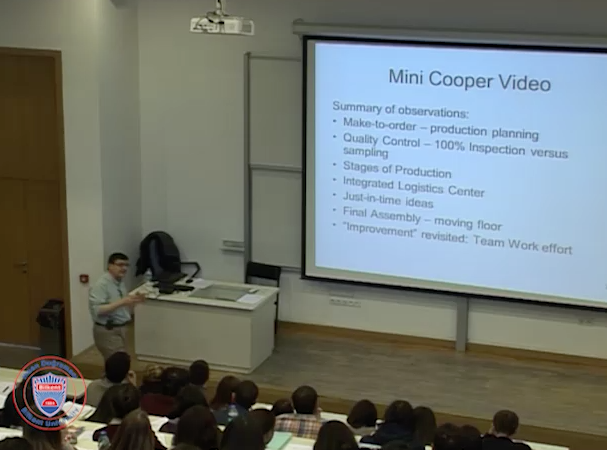
A Manufacturing System - Video: Inisde a Factory
Keywords to remember: "schedule", "layout", make-to-order", "assembly", "quality control", "teamwork", "logistics"
-
Ders 13 (2014-02-27)
Traveling Salesman Problem
Study recommendation: Read C&E pp. 13-24, lecture notes
Keywords to remember: “optimization”, “computational order of an
algorithm”, “NP Hard”, “heuristics
-
Ders 12 (2014-02-27)
Traveling Salesman Problem
Study recommendation: Read C&E pp. 13-24, lecture notes.
Keywords to remember: “optimization”, “computational order of an
algorithm”, “NP Hard”, “heuristics"
-
Ders 11 (2014-02-26)
Networks – Shortest Path Problem
Study recommendation: Read “A Solution Method: Routing Through Networks:
Read Chelst and Edwards (C&E) pp. 1-12”, and lecture notes.
Keywords to remember: “network representation”, “algorithm”
-
Ders 10 (2014-02-26)
Networks – Shortest Path Problem
Study recommendation: Read “A Solution Method: Routing Through Networks:
Read Chelst and Edwards (C&E) pp. 1-12”, and lecture notes.
Keywords to remember: “network representation”, “algorithm”
-
Ders 9 (2014-02-20)
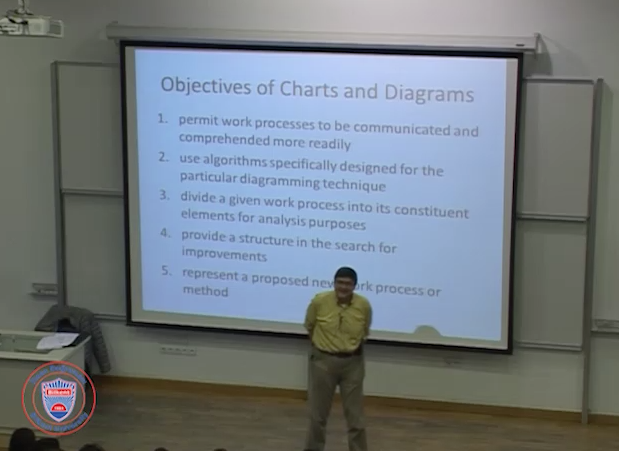
Charts and diagrams; objectives; Flow Diagrams. Discussion
-
Ders 8 (2014-02-19)
Charts and diagrams; objectives; Gantt Chart, Operation Chart, Process Charts Examples.
-
Ders 7 (2014-02-19)
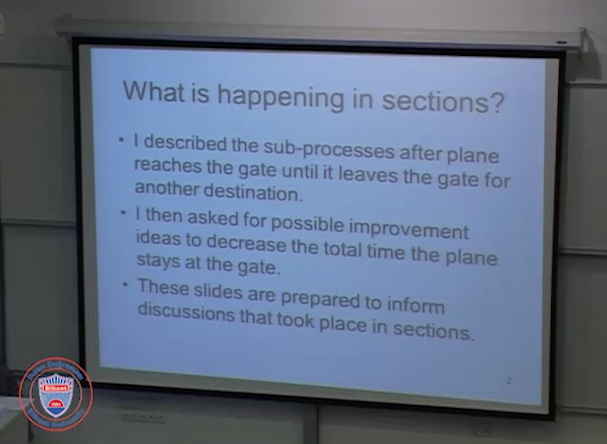
Go over the improvement ideas discussed in sections. Re-emphasize the key-words of the previous week.
-
Ders 6 (2014-02-13)
How to use process knowledge to "solve" IE problems?
Keywords to remember: “performance measure”, “mathematical modeling”,
“complex situations”, “improvement”, “trade-off”
-
Ders 5 (2014-02-13)
How to use process knowledge to "solve" IE problems?
Keywords to remember: “performance measure”, “mathematical modeling”,
“complex situations”, “improvement”, “trade-off”
-
Ders 4 (2014-02-12)
Wrap-up previous week + Process examples: Service Systems.
For each of the clips, observe the processes involved:
1) To understand operations considered;
2) To find out their relation;
3) To conceptualize possible related performance measures;
4) To propose ideas for improvement.
Observation is a very useful complementary tool for understanding
operations, the relations, and finally to initiate critical analysis for
improvement.
-
Ders 3 (2014-02-12)
Wrap-up previous week + Process examples: Service Systems.
For each of the clips, observe the processes involved:
1) To understand operations considered;
2) To find out their relation;
3) To conceptualize possible related performance measures;
4) To propose ideas for improvement.
Observation is a very useful complementary tool for understanding
operations, the relations, and finally to initiate critical analysis for
improvement.
-
Ders 2 (2014-02-05)
Introduction: Course Information. Definition of the word “Process”.
Study recommendation: Read lecture notes, comments on Quiz 1 (when
available).
Keywords to remember: “Process”, “engineering”, “engineered process”,
“decisions embedded into processes”.
-
Ders 1 (2014-02-05)
Introduction: Course Information. Definition of the word “Process”.
Study recommendation: Read lecture notes, comments on Quiz 1 (when
available).
Keywords to remember: “Process”, “engineering”, “engineered process”,
“decisions embedded into processes”.